
Check loaded trailer weight, storage and ramp access, then compare how much of each outing is left afloat with a door-to-door time budget.
A trailer makes sense when you have a suitable tow vehicle, somewhere to keep the complete rig and a usable launch site. A berth makes sense when getting afloat quickly matters more than changing your starting point. Settle those practical questions before choosing a boat by length or advertised dry weight.
Work through three checks: the loaded rig, the route from storage to water and the time left for boating. A boat that fails one of them needs a different ownership plan, even if its purchase price fits.
Count the loaded trailer, not just the hull
Find out what the seller's weight figure includes. “Dry weight” may leave out the fitted engine, batteries, fuel or equipment. The empty trailer also takes part of the towing allowance.
Here is a hypothetical weight worksheet. The hull figure excludes every other item in the table; fuel is entered as a mass, not a tank volume.
| Loaded-rig item | kg |
|---|---|
| Bare hull | 780 |
| Engine | 160 |
| Battery | 35 |
| Fuel carried | 60 |
| Equipment | 65 |
| Empty trailer | 360 |
| Total | 1,460 |
The trailer carries 1,100 kg; with the empty trailer, the car tows 1,460 kg. Compare the first figure with the trailer's payload rating, not with the car's towing limit. If the car's braked-trailer limit were 1,500 kg, the arithmetic leaves just 40 kg. Weigh the rig as it will travel, with water, spares and other kit aboard. Forty kilograms on paper is not a measured safety margin.
Towing capacity is only one check. Verify the trailer's gross and payload limits, the vehicle's gross and train limits, axle loads, and the permitted loads on the towbar and coupling, including nose load. Passengers and luggage in the car also affect vehicle and train loads.
Use documents for the exact vehicle variant: even the variants in this Kia manufacturer's manual have different limits.
Check the licence category, dimensions, registration and insurance requirements for every country on the route with the relevant authorities and insurer. Licence rules can depend on maximum authorised masses, not simply the weight measured that morning. A total below the car's towing limit does not settle those checks.
Walk the route from storage to water
At home or in storage
Measure the complete rig, including drawbar, engine overhang and transport height. Check the gate, turning space, slope and ground, not just the length of the parking space. Confirm that storage and access are permitted and that the car can get in position to hitch up.
At the launch site
Ask the operator about access permission, opening times, ramp gradient and surface, usable water levels, parking for a car and trailer, and somewhere to board passengers. Check whether your vehicle and boat can launch and recover there under the conditions you expect.
Visit when you would normally use the site, rather than judging it on an empty weekday. Include queues and the return journey. A ramp that works at departure may have different water levels, traffic or access conditions when you return.
Falmouth Harbour's launching guidance offers useful planning principles: prepare before entering the ramp, check weather and water conditions, and keep people not involved in launching away from the operation. Follow your own site's instructions and use suitable lifejackets. If you are new to launching and recovery, arrange practical instruction with the actual rig before relying on it for family outings.
How much of a six-hour outing is left afloat?
Use a door-to-door time budget, including the jobs after you get home. In this example, you have six hours, or 360 minutes. All times below are assumed round-trip or whole-outing totals, not measured averages.
Trailer plan: 2 hours 45 minutes afloat
Allow 90 minutes for driving, 35 for hitching, ramp preparation and launching, 45 for recovery and packing, and 25 for stowing and care at home.
That uses 195 minutes ashore, leaving 165 minutes afloat. Include your usual waiting time in those inputs.
Berth plan: 4 hours 20 minutes afloat
Allow 60 minutes for driving, 20 for boarding and departure checks, and 20 for securing the boat on return.
That uses 100 minutes ashore, leaving 260 minutes afloat. In this example the berth provides 95 more minutes on the water per outing.
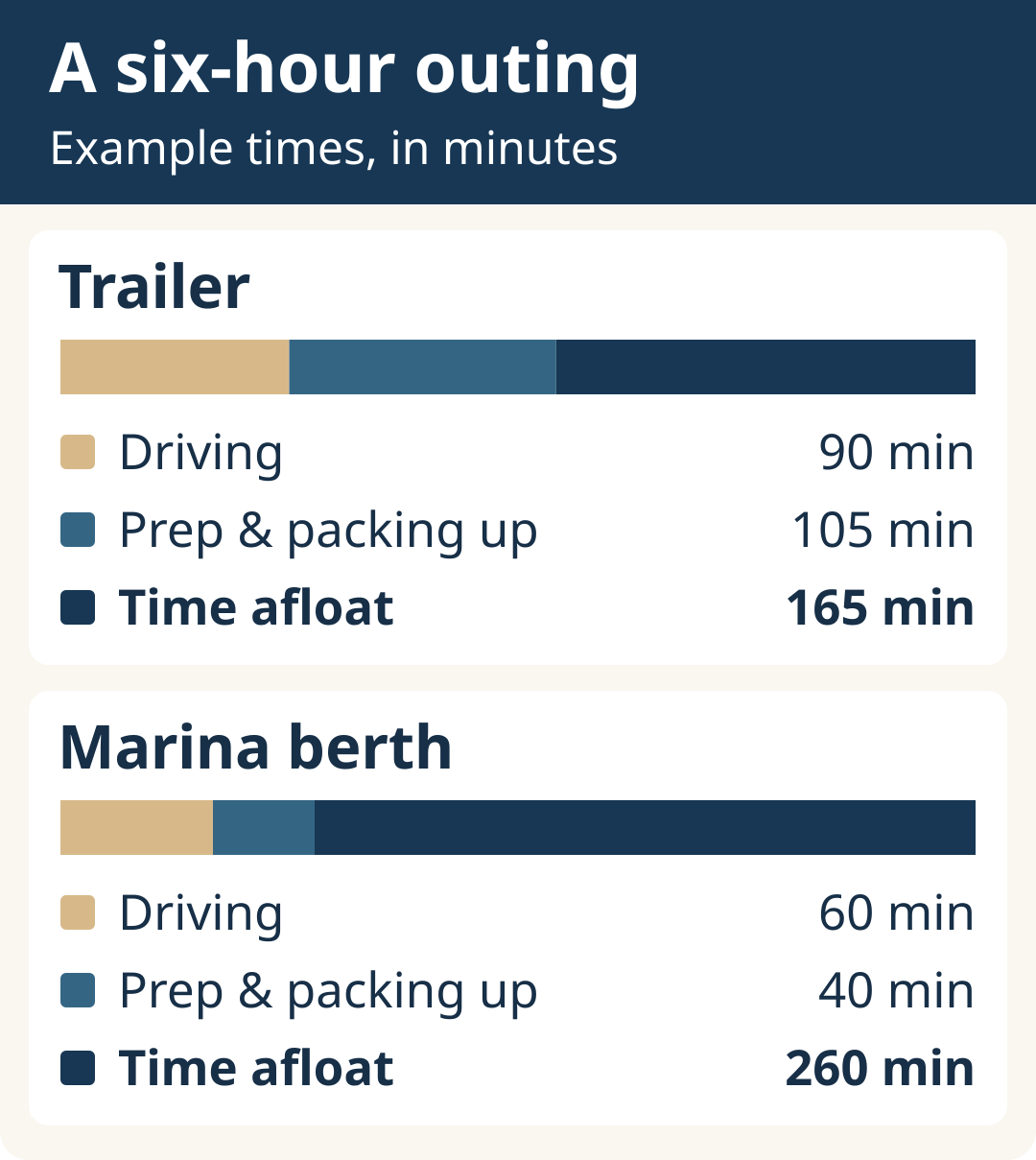
Of those 95 minutes, 30 come from the shorter drive to the marina. The remaining 65 come from the difference in preparation and packing up: 105 minutes with the trailer, 40 at the berth. If both round trips take the same time, use 65 minutes, not 95, for this comparison. Time your own route both ways and include the queue on a busy return.
Over twelve outings, the original example adds up to 19 hours more afloat; with equal driving times it would be 13. Both figures include the passage to and from your destination.
Two owners can choose differently
For twelve short outings from the same place: assume both options pass the weight, access and storage checks. The six-hour example favours a berth if its complete cost fits the budget, because it leaves more of each limited outing for boating.
For four full-day trips from different launch sites: assume a verified suitable rig, permitted storage and checked ramps at each destination. A trailer fits the plan better if the owner accepts the extra handling time and wants those different starting points. Price road travel, launch access, parking and trailer upkeep before deciding it is cheaper.
If the trailer plan needs another car or new storage, include that change before comparing it with a berth. For the storage-price side, use the berth-versus-dry-storage comparison; for the boat itself, return to choosing a boat for your use.
When shortlisting boats on Yahte, ask the seller what the stated weight includes, whether the trailer is part of the sale and what its plate and documents show. Use those answers to rule out unsuitable combinations before arranging a viewing.