A worked annual budget for a 7.5 × 2.5 m boat: published berth prices, estimated servicing, fuel and insurance, plus separate repair-reserve funding.
How much will your boat cost each year? Much depends on where you keep it, how often you use it and the condition of its engine and equipment. A useful budget covers all twelve months, from the first spring service to winter storage.
Our worked example for a 7.5 × 2.5 m boat on the Adriatic comes to about EUR 9,800 a year, or EUR 10,800 with a further EUR 1,000 set aside for repairs. Below are two berth-and-storage calculations, a full annual budget and the costs worth checking before you buy.
Define your boat and twelve-month plan
Write down the boat's overall length and beam, engine count and model, and any work due soon. Choose a berth location and decide how many months it will spend afloat and ashore. Add your expected hours underway and cruising area, and you have the details needed for marina, service and insurance quotations.
Give the marina the boat's actual dimensions. Platforms, bow extensions and beam can affect the tariff category, so two boats with the same advertised length can attract different berth charges.
What belongs in your annual budget?
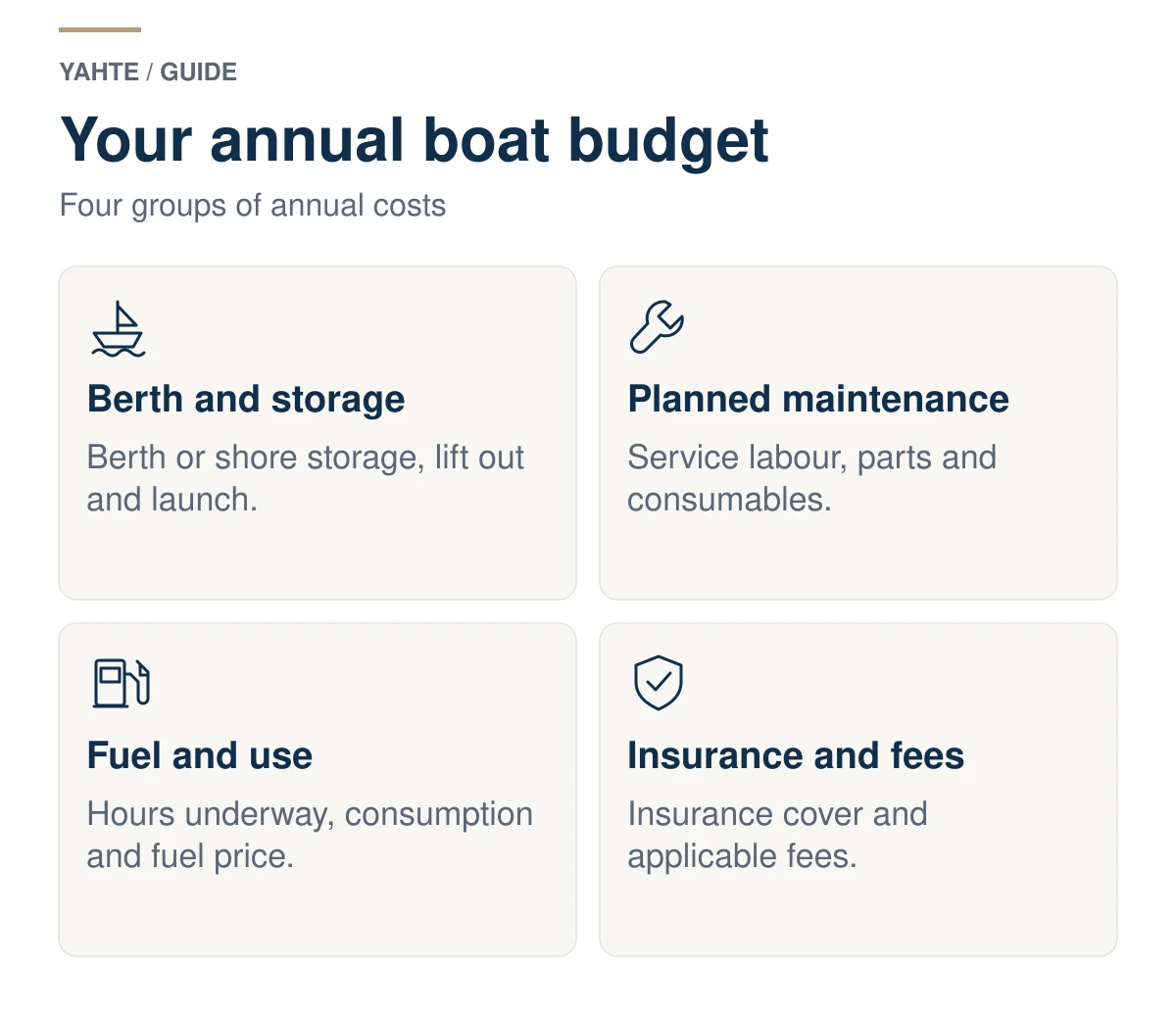
- Berth and storage: time afloat and ashore, lifts and marina extras.
- Maintenance: servicing, parts, consumables and winter preparation.
- Fuel and use: fuel, visitor berths and spending on planned trips.
- Insurance and fees: cover, boat tax, public charges and inspections due.
Alongside regular bills, plan a repair reserve. Give the purchase and initial work their own first-year budget.
What does a berth quotation actually include?
Ask for a VAT-inclusive price for your exact dates and a list of included services. Check electricity, water, parking, lift out and launch, cradle and transport on land. Ask specifically how winter storage is charged: some packages add it to the annual berth price.
Arrange engine winter preparation and other work with the service team. If you keep the boat on a trailer or private land, allow for transport, launching, access and secure storage.
Belgrade example: berth, winter storage, haul-out and launch
Assume a 6.0 m boat, six paid monthly wet-berth periods, six outdoor winter-storage months and one haul-out and launch. Goga YCI's tariff dated 15 April 2026 lists these prices for its 5.50–6.40 m category, excluding 20% VAT:
| Item | Calculation excluding VAT | Including VAT |
|---|---|---|
| Six wet-berth months | 6 × EUR 450 | EUR 3,240 |
| Six outdoor-storage months | 6 × EUR 80 | EUR 576 |
| Haul-out and launch | EUR 140 + EUR 140 | EUR 336 |
| Berth, storage, haul-out and launch subtotal | EUR 3,460 | EUR 4,152 |
That brings the berth, winter storage, haul-out and launch to EUR 4,152 including VAT, using the individual tariff rates. Add servicing, fuel, insurance and public charges to your budget. The subtotal excludes transport between the berth in Novi Beograd and the winter yard in Krnjača. Ask Goga for a quote covering both journeys.
The same tariff lists a regular service for a 60–120 hp outboard at EUR 150 excluding VAT, or EUR 180 including VAT. Consumables cost extra. Electricity and water are also separate tariff items.
Adriatic example: annual berth, winter ashore, haul-out and launch
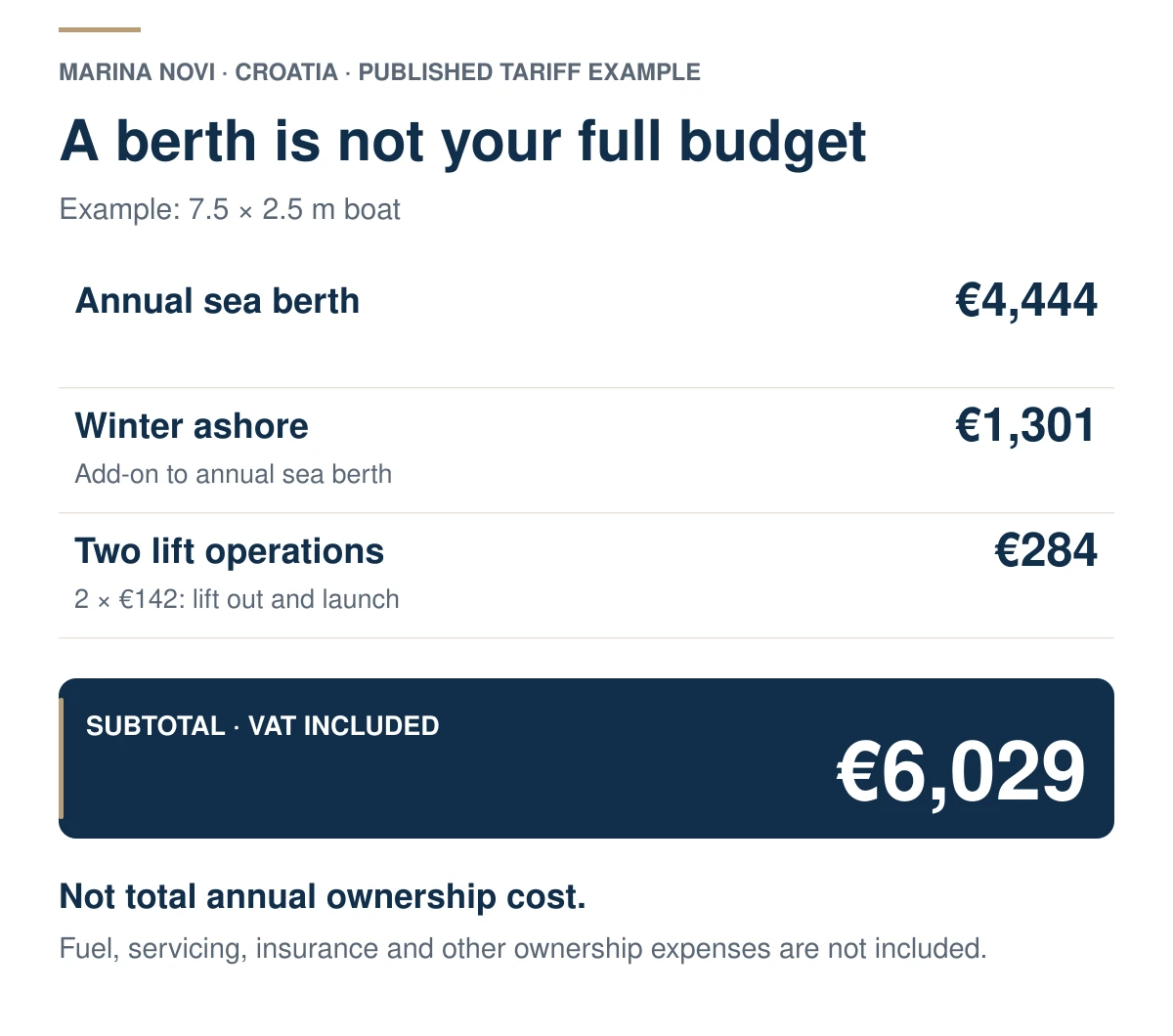
For a private-use 7.5 m × 2.5 m monohull, use the applicable category in Marina Novi's tariff, effective 1 February 2026, in Novi Vinodolski. These figures already include VAT.
| Item | Including VAT |
|---|---|
| Annual sea berth | EUR 4,444 |
| Winter-ashore add-on | EUR 1,301 |
| Haul-out and launch: 2 × EUR 142 | EUR 284 |
| Subtotal of listed services | EUR 6,029 |
The shore-storage add-on is for annual wet-berth customers and covers a stay from 15 October to 15 April, transport on land and one cradle reservation. The lift price includes washing as specified in the tariff. Transport, the cradle and that washing are therefore already covered in this calculation.
What might the full annual budget be for this boat?
For the full budget, take a sound used cabin motorboat: a 7.5 × 2.5 m monohull with one 110 kW petrol four-stroke outboard, approximately 150 hp. Assume private use, existing Croatian registration and an insured value of EUR 40,000. The plan is local day trips without overnight stays. The berth cost comes from the tariff above; the other entries are budget estimates including applicable taxes.
For 50 hours underway at 15 litres per hour and EUR 1.60 per litre, fuel comes to 50 × 15 × 1.60 = EUR 1,200.
| Annual item and basis | EUR |
|---|---|
| Berth, winter ashore, haul-out and launch (published tariff) | 6,029 |
| Engine service and winter preparation | 900 |
| Antifouling renewal and anodes | 600 |
| Liability and hull insurance | 500 |
| Public charges, boat tax and any inspection due | 250 |
| Fuel: assumed 50 h × 15 L/h × EUR 1.60/L | 1,200 |
| Visitor berths EUR 200 + cleaning/minor safety consumables EUR 100 | 300 |
| Total annual cash spending | 9,779 |
The total is about EUR 9,800 a year to run the boat. With a further EUR 1,000 kept aside for repairs, you need EUR 10,779, rounded to EUR 10,800 a year or EUR 900 a month. Saving monthly helps you prepare for the larger berth and preseason bills.
How are the maintenance estimates built? As a labour-rate reference, Punat's 2026 service tariff lists mechanic work at EUR 80 an hour including VAT. Allowing five hours for routine servicing gives EUR 400; we add EUR 300 for parts and fluids and EUR 200 for winter preparation and recommissioning, bringing the service budget to EUR 900.
For routine antifouling renewal, the same tariff lists labour at EUR 9/m² for the first coat and EUR 6/m² for the next, excluding materials. Assuming 20 m² to coat, labour is 20 × (9 + 6) = EUR 300. Adding EUR 250 for coatings and EUR 50 for anodes gives EUR 600. The area, work hours and material budgets are inputs to this example; your service team can size the work for your boat. Lifts and washing are already in the marina calculation. The owner handles cleaning and routine checks; add paid winter supervision and major overdue work where needed.
The insurance budget is EUR 500 for liability and hull cover. For comparison, Wiener's published compulsory liability premium for private use is EUR 47.48 for documented engine power above 50 kW and up to 110 kW. Replace the EUR 500 budget with an individual quotation for both covers, checking the deductible, cruising area and marina requirements.
The EUR 250 set aside for public obligations includes the EUR 66 annual boat tax for this cabin-motorboat length and power category. The Croatian ministry also identifies separate annual navigation-safety and maritime-domain charges. Its inspection information and linked tariff list a EUR 53 base fee for a regular inspection of a boat over 7 m and up to 12 m with power above 15 kW. Include an inspection in the year it falls due; confirm the date, location-related charges and annual assessments with the harbourmaster's office to replace this allowance.
Berth, winter storage, haul-out and launch account for about 62% of this example's annual spending. For this boat, Marina Novi charges EUR 1,070 for one month afloat or EUR 4,444 for an annual berth. Use the rate for the contract you choose, not both. For a shorter stay, compare a berth with dry storage. A lower berth price is useful only if access, transport and services still work for your plans.
Cutting use from 50 to 30 hours saves EUR 480 in fuel, with other costs held fixed: fuel falls to EUR 720 and annual spending to EUR 9,299. At 80 hours, fuel rises to EUR 1,920 and the annual total to EUR 10,499. Fewer trips reduce fuel spending, but leave the annual berth and many calendar-based bills in place.
For longer trips, add personal travel, food, accommodation and any applicable overnight or tourist charges. Put major engine or equipment replacements in the year they fall due, using the survey and maintenance schedule.
How to estimate fuel and maintenance
Fuel cost = hours underway × litres per hour × price per litre. For your own calculation, use consumption at your usual load and speed, then check the price where you plan to refuel. Sea-trial figures or the previous owner's records are more useful than engine power alone.
Ask the service team to quote labour and materials separately for your engine and drive. Check calendar-based maintenance intervals too: some jobs fall due even in a season with little use.
First year is different from recurring maintenance
The first year also brings a survey, sea trial, delivery, ownership transfer, initial repairs and equipment purchases. Put these alongside the purchase price. For the buying process, see the Adriatic used-boat buying guide; for condition checks, use the used-boat inspection checklist.
For a longer-term view, consider depreciation, financing costs and money tied up in the purchase separately. You will then have both a picture of yearly bills and a broader view of ownership costs.
Build your budget before committing
Make a simple table: item, tax-inclusive amount, period, source and quotation date. Mark what is confirmed and which prices you still need. Add scheduled work and a separate repair fund, then see how the total changes with more or fewer hours underway.
With the purchase and the following year in one plan, narrowing your shortlist becomes easier. Compare listings by condition, equipment and the annual costs you can comfortably cover.